Table of Contents
Search engine optimisation is becoming increasingly complex. Businesses are managing thousands of keywords, hundreds of pages, ongoing content updates, technical audits, and competitive analysis across multiple channels. Traditional SEO processes often require significant manual effort, making it difficult for teams to scale efficiently.
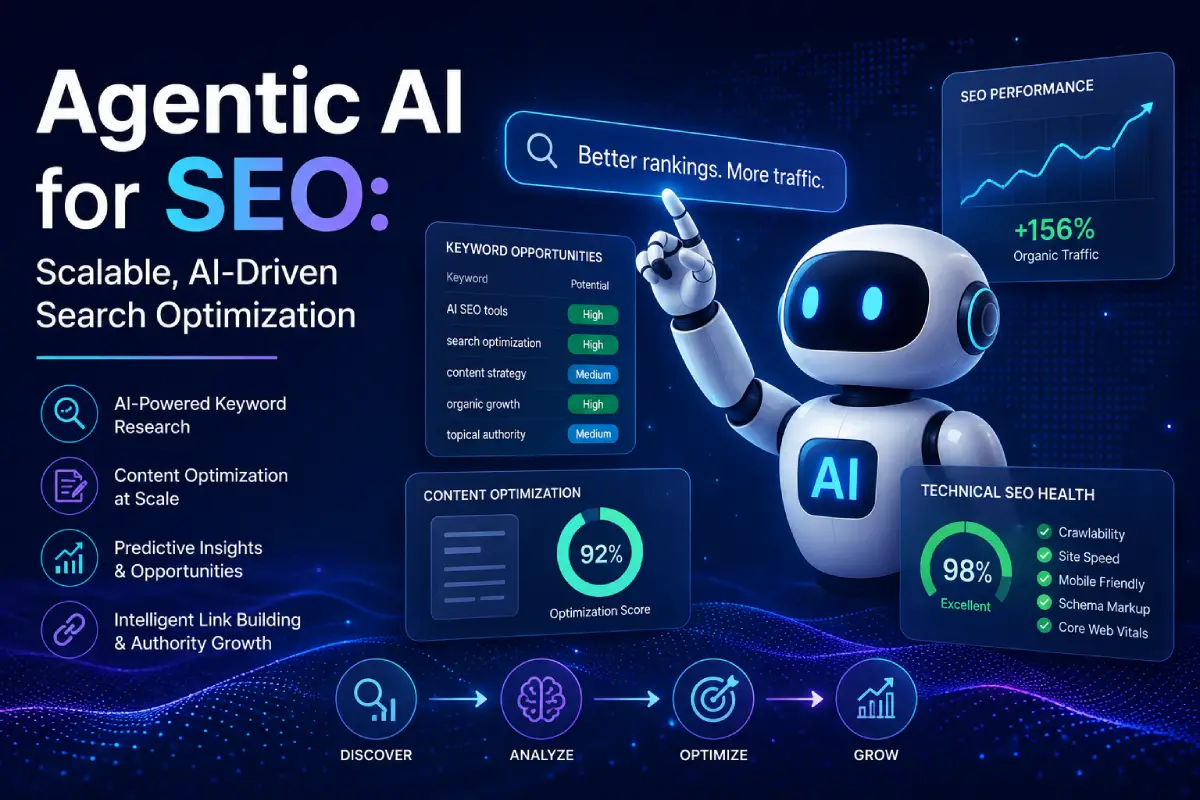
This is where Agentic AI for SEO is transforming the industry. Rather than simply generating content or analyzing data, AI agents can perform multi-step SEO tasks, automate workflows, and continuously optimize campaigns. The result is faster execution, improved consistency, and greater scalability.
At the forefront of this evolution, Harsh Mittal | SEO Expert & Digital Marketing Strategist leverages in-house AI agents to automate high-volume SEO workflows across keyword research, content audits, page optimization, publishing, and technical monitoring. Built on live campaign data, these intelligent systems help SEO teams move faster while maintaining expert oversight and strategic control.
What is Agentic AI for SEO?
Agentic AI for SEO refers to autonomous AI systems that can plan, execute, monitor, and optimize SEO activities with minimal human intervention. Unlike traditional automation tools that perform isolated tasks, AI agents work toward specific SEO objectives by making data-driven decisions and completing connected workflows.
These advanced systems combine SEO artificial intelligence, machine learning, natural language processing, and workflow orchestration to streamline complex SEO operations.
Examples include:
- Automated keyword discovery and clustering
- AI content audits and recommendations
- Technical SEO automation
- Content publishing workflows
- Automated SEO monitoring
- Competitor tracking and analysis
As search algorithms continue evolving, businesses need scalable systems capable of adapting quickly. This is where AI-powered SEO becomes a competitive advantage.
The Rise of AI-Driven SEO
Modern search environments generate enormous amounts of data. SEO professionals must analyze rankings, user behavior, search intent, technical issues, content performance, and competitor strategies.
AI-driven SEO enables marketers to process this information at scale and transform insights into action.
Instead of spending hours manually reviewing reports, AI systems can:
- Identify ranking opportunities
- Detect content gaps
- Recommend on-page improvements
- Monitor technical issues
- Prioritize optimization tasks
- Forecast SEO performance trends
This level of automation allows SEO teams to focus on strategy while AI handles repetitive and time-consuming activities.
The growing adoption of digital marketing AI is also changing how organizations approach search visibility. Businesses can now make faster decisions based on real-time insights, helping them stay ahead of competitors and adapt quickly to algorithm updates.
How AI SEO Agents Transform SEO Workflows
One of the most significant advancements in search engine optimization is the emergence of AI SEO agents.
These agents function like digital team members capable of handling specific SEO responsibilities.
1. Keyword Research Automation
Keyword research remains the foundation of successful SEO campaigns. However, manually discovering, grouping, and prioritizing keywords can take days.
Through keyword research automation, AI agents can:
- Analyze search trends
- Identify high-intent keywords
- Group terms by search intent
- Discover long-tail opportunities
- Map keywords to landing pages
This process dramatically reduces research time while uncovering opportunities that might otherwise be overlooked.
AI can also identify seasonal trends, emerging topics, and competitor keyword gaps, enabling businesses to create content strategies that align with user demand.
2. Content Optimization AI
Creating content is only the first step. Continuous optimization is necessary to maintain rankings and improve performance.
Content optimization AI helps businesses:
- Improve keyword relevance
- Enhance topical coverage
- Optimize headings and structure
- Increase semantic relevance
- Align content with search intent
AI systems can review hundreds of pages simultaneously and prioritize updates based on potential impact.
This capability ensures that content remains competitive, relevant, and aligned with evolving search engine requirements.
AI Content Audits at Scale
Large websites often contain thousands of pages, making manual audits nearly impossible.
With AI content audits, organizations can automatically evaluate:
- Content quality
- Keyword usage
- Internal linking
- Readability
- Metadata optimization
- Content freshness
AI identifies underperforming pages and recommends specific improvements, allowing teams to maintain content quality across large websites.
For enterprises managing extensive content libraries, this capability significantly improves efficiency and performance.
Additionally, AI-powered audits can detect duplicate content, cannibalization issues, and outdated information that may negatively impact rankings.
Technical SEO Automation: Eliminating Bottlenecks
Technical SEO is essential for search visibility but often requires substantial manual effort.
Technical SEO automation allows AI systems to continuously monitor websites and detect issues before they affect rankings.
Common automated tasks include:
- Crawl error detection
- Broken link monitoring
- Indexation analysis
- Schema validation
- Core Web Vitals monitoring
- Site architecture reviews
Rather than waiting for periodic audits, businesses receive real-time insights and recommendations.
This proactive approach reduces risks and improves overall site health.
By automating technical checks, SEO teams can spend less time troubleshooting and more time focusing on strategic growth initiatives.
SEO Workflow Automation for Maximum Efficiency
SEO involves multiple interconnected tasks. Managing them manually often creates bottlenecks and inconsistencies.
SEO workflow automation enables organizations to streamline processes from start to finish.
An automated workflow may include:
- Keyword discovery
- Topic generation
- Content creation briefs
- Content audits
- On-page optimization
- Publishing approval
- Performance monitoring
- Reporting and recommendations
When AI agents manage these workflows, teams gain greater consistency while significantly reducing turnaround times.
This level of automation is particularly valuable for agencies and enterprise organizations managing multiple websites and campaigns simultaneously.
Automated SEO Monitoring and Reporting
SEO performance changes daily. Rankings fluctuate, competitors update content, and technical issues emerge unexpectedly.
Through automated SEO monitoring, AI agents continuously track:
- Keyword rankings
- Organic traffic
- Technical health
- Competitor movements
- Conversion metrics
- Search visibility trends
Instead of manually reviewing dashboards, marketers receive actionable alerts and prioritized recommendations.
This allows organizations to respond faster and protect search performance.
Advanced monitoring systems can even predict potential ranking declines before they occur, helping businesses take preventive action.
Enterprise SEO Automation for Large Organizations
Large enterprises face unique SEO challenges due to the scale of their websites and content ecosystems.
Enterprise SEO automation provides a practical solution by enabling organizations to manage thousands of pages efficiently.
Benefits include:
- Consistent optimization standards
- Faster content production
- Scalable auditing processes
- Reduced manual workload
- Improved cross-team collaboration
- Greater operational efficiency
Enterprise businesses increasingly rely on search engine optimization AI to maintain competitiveness in rapidly changing search environments.
For multinational brands, AI-driven systems can also support multilingual SEO, localization efforts, and region-specific optimization strategies.
AI SEO Strategy: Combining Automation with Expertise
While AI delivers speed and scalability, human expertise remains essential.
An effective AI SEO strategy combines:
- AI-powered data analysis
- Automated execution
- Strategic human oversight
- Business-specific decision-making
At Harsh Mittal’s digital marketing practice, AI agents are designed to support—not replace—SEO expertise. These systems automate repetitive tasks while experienced professionals guide overall strategy, content direction, and business goals.
This hybrid approach produces stronger outcomes than either humans or AI working independently.
The most successful organizations use AI as an enhancement tool, allowing SEO specialists to focus on creativity, strategic planning, and business growth.
Benefits of Agentic AI for SEO
Organizations adopting Agentic AI for SEO can experience several measurable advantages:
Increased Productivity
AI agents eliminate repetitive manual tasks, allowing teams to focus on higher-value activities. This makes them powerful SEO productivity tools for modern marketing teams.
Improved Accuracy
AI systems analyze large datasets with consistency, reducing human error and ensuring optimization recommendations are based on reliable insights.
Faster Execution
Tasks that once required days or weeks can now be completed in hours, accelerating campaign performance and time-to-market.
Better Scalability
Businesses can manage larger websites, more content, and broader keyword portfolios without significantly increasing resources.
Data-Driven Decision Making
AI-powered insights help organizations make informed decisions based on real-time performance metrics and search trends.
The Future of AI-Powered Search Optimization
As search engines continue evolving, AI-powered search optimization will become a standard component of modern SEO operations.
Future developments will likely include:
- Advanced predictive SEO models
- Real-time content optimization
- Autonomous technical issue resolution
- Personalized search experiences
- Smarter AI SEO agents
- Enhanced digital marketing AI capabilities
Businesses that embrace AI early will gain significant advantages in efficiency, scalability, and search visibility.
As AI technology matures, organizations will increasingly rely on intelligent systems to manage complex SEO ecosystems while maintaining strategic oversight from experienced professionals.
Conclusion
The future of SEO lies in intelligent automation. Agentic AI for SEO enables businesses to automate complex workflows, improve consistency, and scale optimization efforts without sacrificing quality.
From keyword research automation and AI content audits to technical SEO automation and automated SEO monitoring, AI is reshaping how search optimization is executed.
By combining AI-driven SEO, expert oversight, and data-backed decision-making, organizations can build truly scalable SEO solutions that deliver sustainable growth.
As the industry continues evolving, businesses that adopt SEO automation, leverage SEO productivity tools, and implement a robust AI SEO strategy will be best positioned to succeed in the next generation of search.
For brands looking to stay competitive in an increasingly data-driven landscape, investing in AI SEO agents, search engine optimization AI, and advanced SEO workflow automation is no longer optional—it is becoming a critical component of long-term digital success. With the right balance of automation and expertise, organizations can unlock new levels of efficiency, visibility, and growth in organic search.