
For more than two decades, digital marketers have chased one goal:
Rank #1 on Google.
Businesses invested thousands of dollars in SEO campaigns, content marketing, backlinks, technical optimization, and keyword research—all to secure top positions in search engine results.
But in 2025, something fundamental changed.
Users are no longer clicking through ten blue links.
Instead, they are asking AI-powered search engines questions and receiving direct answers.
Whether it’s ChatGPT, Google AI Overviews, Gemini, Perplexity, Claude, or Microsoft Copilot, AI now acts as the intermediary between users and websites.
As a result, many businesses are facing a surprising reality:
You can rank #1 on Google and still be invisible to your customers.
This shift has given rise to a new discipline known as Generative Engine Optimization (GEO)—a strategy designed to help brands appear inside AI-generated answers rather than merely ranking on traditional search results.
In this guide, you’ll learn why traditional SEO is losing effectiveness, how GEO works, and what businesses must do today to stay visible in the future of search.
The New Search Reality
Let’s start with a simple example.
Imagine a user searches:
“What is the best CRM software for small businesses?”
Five years ago, Google displayed a list of websites.
The user clicked one result, read an article, compared options, and eventually made a decision.
Today, AI tools provide a complete answer instantly.
The user receives:
- Recommended CRM platforms
- Key features
- Pricing insights
- Pros and cons
- Buying recommendations
All without visiting multiple websites.
This is called zero-click search behavior.
Users get answers directly from AI-generated responses.
The consequence?
Website traffic patterns are changing dramatically.
Many businesses report:
- Declining organic clicks
- Lower CTR despite stable rankings
- Reduced website visits
- Increased brand invisibility in AI answers
Ranking high is no longer enough.
Being cited by AI systems is becoming the new visibility metric.
The Problem: Ranking High but Invisible in AI
A growing number of businesses are discovering a frustrating issue.
Their SEO performance looks strong:
✅ First-page rankings
✅ High domain authority
✅ Quality backlinks
✅ Well-optimized content
Yet when users ask ChatGPT or Google AI Overviews relevant questions, their brand never appears.
Why?
Because AI engines evaluate information differently than traditional search engines.
Google’s classic ranking algorithm focused heavily on:
- Keywords
- Backlinks
- Technical SEO
- Page authority
Generative AI systems focus more on:
- Contextual relevance
- Entity recognition
- Trustworthiness
- Structured information
- Source consistency
- Citation quality
In other words:
A website optimized for Google rankings isn’t automatically optimized for AI visibility.
This creates a major visibility gap.
Businesses may technically rank but fail to become part of the answers users actually see.
Why Traditional SEO Is Failing in 2025
SEO isn’t dead.
But it is evolving.
Several major trends are reshaping how people discover information online.
1. AI Is Replacing Search Results
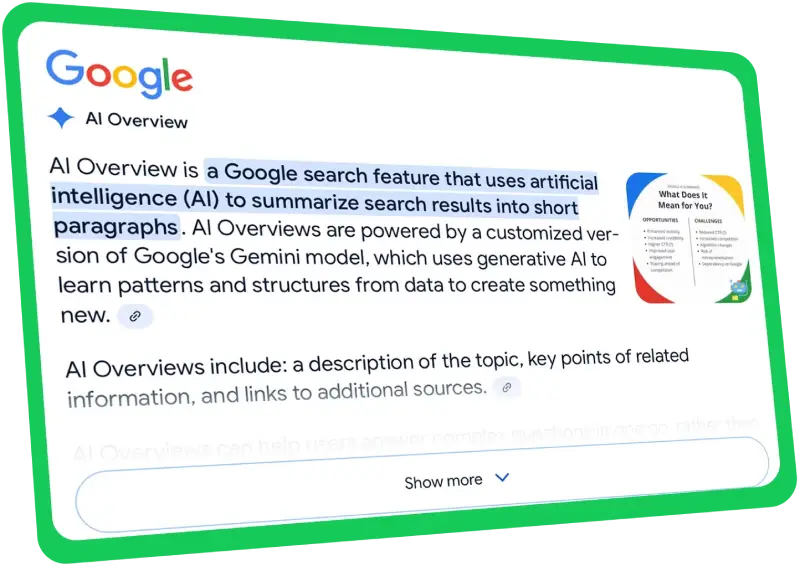
Google AI Overviews now answer millions of queries directly.
Instead of showing ten links, Google increasingly provides summarized responses generated from multiple sources.
Users often get what they need without clicking.
The result:
- Fewer website visits
- Lower CTR
- Reduced organic traffic
Even highly ranked pages may receive significantly less traffic than before.
2. Users Are Asking Conversational Questions
Traditional SEO focused on keywords like:
- SEO services
- CRM software
- Running shoes
Modern users ask:
- Which CRM software is best for startups?
- What are the most effective SEO strategies for AI search?
- Which running shoes are best for marathon training?
AI understands intent rather than exact keywords.
Businesses relying solely on keyword-focused content may struggle to appear in these conversational searches.
3. Authority Signals Have Changed
Backlinks remain valuable.
However, AI systems increasingly evaluate:
- Brand mentions
- Expert citations
- Knowledge graph associations
- Industry recognition
- Consistent information across sources
A brand mentioned across trusted websites may outperform a higher-ranking competitor with stronger backlinks.
4. Search Is Becoming Multi-Platform
People now search through:
- ChatGPT
- Google AI Overviews
- Gemini
- Perplexity
- Copilot
- Voice assistants
- AI-powered browsers
Traditional SEO primarily targeted Google.
Modern visibility requires optimization across multiple AI ecosystems.
5. AI Prioritizes Answers, Not Pages
Search engines rank pages.
AI systems generate answers.
This distinction changes everything.
Instead of asking:
“How do I rank higher?”
Businesses must ask:
“How do I become part of the answer?”
That’s where Generative Engine Optimization comes in.
What Is Generative Engine Optimization (GEO)?
Generative Engine Optimization (GEO) is the process of optimizing your content, website, and brand presence so AI-powered search engines can discover, understand, trust, and cite your information in generated responses.
Unlike traditional SEO, GEO focuses on increasing visibility within AI-generated answers.
The goal is not simply ranking.
The goal is becoming a trusted source.
How GEO Works
Think of GEO as helping AI systems answer three questions:
Question 1: Who Are You?
AI needs clear entity recognition.
Your brand should be easily understood through:
- About pages
- Author profiles
- Organization schema
- Consistent branding
- Knowledge graph signals
Question 2: Can You Be Trusted?
AI models favor trustworthy information.
Trust signals include:
- Expert authorship
- Citations
- Reviews
- Case studies
- Third-party mentions
- Industry authority
Question 3: Is Your Content Useful for Answers?
AI prefers content that is:
- Structured
- Fact-based
- Clear
- Comprehensive
- Easy to summarize
Content that directly answers questions is more likely to be referenced.
GEO vs Traditional SEO
| Traditional SEO | Generative Engine Optimization |
|---|---|
| Focuses on rankings | Focuses on AI citations |
| Optimizes pages | Optimizes entities |
| Measures clicks | Measures visibility |
| Relies heavily on keywords | Relies on context and authority |
| Google-centric | Multi-platform AI visibility |
| Link building focused | Trust and citation focused |
The future belongs to businesses that combine both.
SEO gets you discovered.
GEO gets you recommended
Real Case Study: From Rankings to AI Visibility
Business Profile
A B2B SaaS company offering project management software.
Initial Situation
The company ranked:
- #2 for project management software
- #4 for team collaboration tools
- #3 for workflow management platform
Traffic was stable.
However, AI searches revealed a major issue.
When users asked:
“Best project management software for remote teams”
AI platforms consistently recommended competitors.
The brand was absent.
GEO Implementation
The company introduced several GEO improvements:
Structured Entity Optimization
- Organization schema
- Product schema
- FAQ schema
- Author schema
Authority Building
- Expert-led content
- Industry reports
- Original research
Conversational Content
Created pages answering:
- What project management software works best for remote teams?
- How do distributed teams improve collaboration?
- What tools reduce remote work communication issues?
Third-Party Mentions
Secured:
- Industry publications
- Software review sites
- Podcast interviews
- Expert roundups
Results After Six Months
AI Visibility
Increased significantly across:
- ChatGPT
- Perplexity
- Gemini
- Google AI Overviews
Organic Performance
- 38% increase in branded searches
- 27% increase in qualified leads
- 42% increase in demo requests
Key Insight
The biggest growth didn’t come from rankings.
It came from becoming part of AI-generated recommendations
3 GEO Strategies Every Business Needs
Strategy #1: Build Topic Authority, Not Just Pages
Many companies create isolated content pieces.
AI prefers complete topic coverage.
Instead of publishing:
- What is SEO?
Create a content ecosystem:
- What is SEO?
- Technical SEO guide
- On-page SEO guide
- AI SEO guide
- GEO guide
- SEO case studies
Comprehensive topic clusters help AI understand expertise.
Action Steps
- Create pillar pages
- Develop supporting content
- Cover entire user journeys
- Update content regularly
Strategy #2: Optimize for Entities
AI systems understand entities better than keywords.
An entity can be:
- Brand
- Person
- Product
- Service
- Organization
Your business should have clear entity signals.
Action Steps
Implement Schema Markup
Use:
- Organization Schema
- Person Schema
- FAQ Schema
- Product Schema
- Service Schema
Maintain Consistent Branding
Ensure:
- Same company name everywhere
- Same descriptions
- Same social profiles
- Same contact details
Strengthen Knowledge Graph Presence
Build references across:
- Industry websites
- Directories
- Publications
- Podcasts
- Social platforms
Strategy #3: Create AI-Friendly Content
AI systems prefer content that is easy to understand and summarize.
Best Practices
Answer Questions Directly
Instead of:
“Many people wonder whether SEO is still important…”
Use:
“SEO remains important because it helps search engines understand and rank content.”
Use Clear Headings
Good structure improves AI comprehension.
Example:
- What is GEO?
- Why GEO matters
- How GEO works
- GEO implementation steps
Add Data and Statistics
AI systems prefer factual content.
Include:
- Research
- Surveys
- Benchmarks
- Original findings
Include FAQs
FAQ sections provide ready-made answers AI engines can reference.
Example:
What is Generative Engine Optimization?
Generative Engine Optimization is the process of optimizing content and digital assets so AI-powered search platforms can discover, trust, and cite them within generated answers.
The Future of Search: Visibility Over Rankings
For years, SEO success was measured by rankings.
The future requires a different mindset.
Businesses must track:
Traditional Metrics
- Rankings
- Organic traffic
- Backlinks
- CTR
GEO Metrics
- AI citations
- Brand mentions
- AI referral traffic
- Knowledge graph presence
- Entity authority
- Answer inclusion rate
The winners of the next decade won’t simply rank higher.
They will become the sources AI trusts.
GEO Implementation Checklist
Technical Foundation
✔ Schema markup
✔ Crawlability
✔ Fast website performance
✔ Mobile optimization
✔ Structured data
Content Optimization
✔ Topic clusters
✔ FAQ content
✔ Conversational answers
✔ Original research
✔ Expert insights
Authority Building
✔ Brand mentions
✔ Digital PR
✔ Industry citations
✔ Expert authors
✔ Case studies
AI Visibility
✔ Entity optimization
✔ Consistent branding
✔ Knowledge graph signals
✔ AI-friendly content structure
✔ Citation-worthy resources
Final Thoughts
The search landscape is undergoing its most significant transformation since Google’s creation.
Users are moving away from traditional search results and toward AI-generated answers.
This means businesses can no longer rely solely on rankings, backlinks, and keywords.
To remain visible, brands must embrace Generative Engine Optimization and position themselves as trusted sources that AI platforms can confidently cite.
The businesses that adapt now will dominate AI search visibility in the years ahead.
The businesses that don’t risk becoming invisible—even if they still rank on page one.
Ready to Improve Your AI Search Visibility?
Get a Free GEO Audit & Consultation
Discover:
✅ Whether ChatGPT can find your business
✅ If Google AI Overviews mention your brand
✅ Your current AI visibility score
✅ GEO opportunities your competitors are missing
✅ A custom roadmap to improve AI citations and authority
Book your Free Generative Engine Optimisation Audit today and future-proof your search strategy before your competitors do.